REMIT 2: Key dates and changes under Implementing Regulation (EU) 2026/256
New reporting deadlines, standard and non-standard contracts, exposure reporting and new obligations until 2029 at a glance
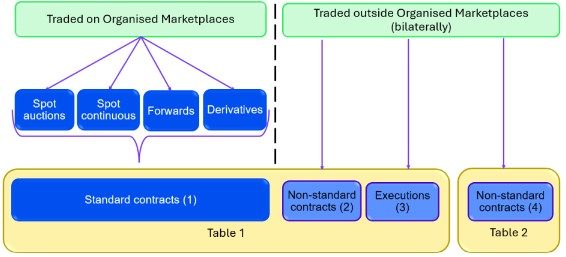
Purpose of Implementing Regulation (EU) 2026/256: It implements Article 7c(2), Article 8(1a), 8(2) and 8(6) of Regulation (EU) No 1227/2011, which governs the integrity and transparency of the wholesale energy market, and replaces Implementing Regulation (EU) No 1348/2014.
| Date | What it means |
|---|---|
| 9 April 2026 | Publication of Implementing Regulation (EU) 2026/256 in the Official Journal of the EU. |
| 29 April 2026 | Entry into force of the recast REMIT IR. Some new obligations already apply from this date, in particular new reporting deadlines. |
| 29 October 2026 | ACER to publish guidance and electronic formats for several new reporting areas, including exposure reporting, continuous transaction reporting, final customer reporting ≥ 600 GWh/year and exogenous data for OMPs. |
| 1 January 2027 | Exposure reporting starts to apply. The first report is due later. |
| 29 April 2027 | ACER guidance and formats for several reporting areas of the second wave, e.g. capacity mechanisms, balancing, gas storage, trade-matching systems and inside information reporting. |
| 29 October 2027 | First major reporting wave: new rules and formats for continuous transaction reporting, including electricity and gas supply, electricity storage, transportation capacity and certain final customer contracts. |
| 31 October 2027 | First exposure report due. Quarterly thereafter. |
| 29 April 2028 | Second reporting wave: including capacity mechanisms, balancing services, gas storage, imbalance settlement data and inside information reporting under the new requirements. |
| 1 July 2028 | Hydrogen reporting starts to apply. |
| 31 January 2029 | First hydrogen report due, covering 1 July 2028 to 31 December 2028. |
The most important short-term change concerns the reporting deadlines:
| Contract type | New deadline |
|---|---|
| Standard contracts | T+2, i.e. within 2 working days |
| Non-standard contracts | T+10, i.e. within 10 working days |
| Lifecycle events | Same deadline as the underlying contract: T+2 or T+10 |
Note: ACER expects reporting parties to meet the new reporting deadlines from 29 April 2026. This means that the previous deadlines still apply to transactions where the trade conclusion, order placement, end of auction (gate closure) or lifecycle event took place before 29 April 2026.
Example:
The reporting deadline for LNG market data remains unchanged: LNG data must be reported as close to real time as technologically possible once a transaction has been finally agreed or bids or offers have been placed.
See Open Letter on the Implications of Regulation (EU) 2026/256 on Data Reporting, §8
The Regulation introduces new definitions:
Transaction now covers trades, orders, bilateral contracts, their executions and lifecycle events.
Lifecycle event covers, for example, the modification, cancellation, correction, early termination or execution of a trade, an order or a bilateral contract.
ACER regards these definitions essentially as a confirmation of existing practice.
The definition is simplified:
| Category | Meaning |
|---|---|
| Standard contract | A contract traded on an organised marketplace |
| Non-standard contract | A contract concluded outside an organised marketplace, i.e. OTC/bilateral |
Important: According to ACER, a bilateral contract is generally non-standard if it was concluded outside an OMP, even if it is based on a product that could be traded on an exchange.
See Open Letter on the Implications of Regulation (EU) 2026/256 on Data Reporting, §7, page 7
See DRAFT version TRUM 8, §9, page 7

The existing reporting formats under Implementing Regulation (EU) No 1348/2014 partly continue to apply until the new rules actually become applicable.
Key points:
New obligations for OMPs from 29 April 2026
Organised marketplaces receive new or extended obligations:
System-generated orders are coming, but not immediately
System-generated orders generally fall under the order book definition. However, reporting only starts upon ACER's request. According to the Open Letter, ACER does not plan to require this reporting from 29 April 2026.
New obligation to provide exogenous data to OMPs
From 29 October 2027, market participants must provide the OMP with information that the OMP does not yet hold but needs for reporting. Examples:
This information must be provided to the OMP no later than the relevant reporting time.
Electricity storage contracts are generally to be treated like contracts for the supply of electricity. In ACER's view, electricity storage systems, such as batteries, should be treated as consumption or production units to the extent that they function as such. The related trading activity is therefore considered trading in electricity supply.
ACER clarifies:
Exposure reporting becomes a new reporting stream. Key points:
LNG market data will initially continue to be reported via TERMINAL.
From 29 October 2027, LNG market data is to be reported to ARIS via RRMs. Reporting will then be based on a new electronic format, as the new Table 1 applies from that date.
See Open Letter on the Implications of Regulation (EU) 2026/256 on Data Reporting, §12
New periodic reports
From 29 April 2028, several new periodic reporting obligations apply, including:
Changes to electricity fundamental data
The main addition for electricity fundamental data:
Example: data for March must be reported by the end of June.
Changes to gas fundamental data
Several points change for gas fundamental data:
Inside information reporting is extended
REMIT II brought new wholesale energy products into the scope of REMIT: hydrogen and electricity storage. ACER clarifies that the obligation to publish inside information also applies to these new products. The obligation to disclose inside information applies regardless of whether the specific reporting obligation for these products has already started or starts later.
From 29 April 2028, inside information reports must be submitted under the new requirements. Reporting is to be continuous, generally T+1 after publication or update, in accordance with the Delegated Regulation (EU) 2026/255 on RRMs and IIPs.
Hydrogen reporting starts later:
Impact on hydrogen reporting
From 1 July 2028, market participants active in the hydrogen market are required to submit annual reports on their transactions. Further details will be published by the end of 2027.
ACER will continue to work with market participants and competent authorities to ensure a smooth transition to the new requirements and to provide the necessary additional guidance.
Conclusion
The new rules of Regulation (EU) 2026/256 require a comprehensive adjustment of data reporting in the wholesale energy market. The switch to new reporting formats and the introduction of additional reporting obligations, such as for hydrogen and storage transactions, are the most important changes. Market participants should prepare for the transition periods and the specific reporting requirements.