ACER REMIT FAQ for Standard & Non-Standard Contracts
Key terms and practical questions about reporting of standard and non-standard contracts under ACER REMIT.


Key terms and practical questions about reporting of standard and non-standard contracts under ACER REMIT.
Please note: The definition was amended with effect from 29 April 2026.
Under the recast REMIT Implementing Regulation:
The EU has adopted a recast REMIT data reporting framework (Commission Implementing Regulation (EU) 2026/256). From 29 April 2026, ACER clarified updated definitions and reporting timelines for standard vs non-standard contracts.
Transition example: If a non-standard contract is concluded on 28 April 2026 (one day before entry into force of the recast REMIT IR), the one-month reporting timeframe still applies, and the transaction needs to be reported at the latest on 28 May 2026. Whilst if the transaction occurs on 29 April 2026, it will have to be reported at the latest by 13 May 2026 (T+10 business days under the new framework).
Most provisions apply with a transition period, but reporting parties should already align their processes with the new timelines.
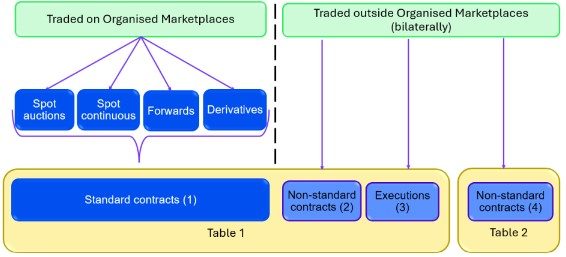
→ Report using Table 1 (REMITTable1) within T+10 business days
→ Report the framework contract using Table 2 (REMITTable2) within T+10 business days
→ When price and quantity become known, report the related EXECUTION using Table 1, linked to the Table 2 Contract ID
Executions under non-standard/framework contracts are reported once the delivered quantity and final price are confirmed by the parties (often after delivery and commercial reconciliation). (TRUM v7.0, sections 3.1.5, 3.1.6 and 3.3.2)
Lifecycle events are changes after initial reporting and must also be reported within the applicable deadlines:
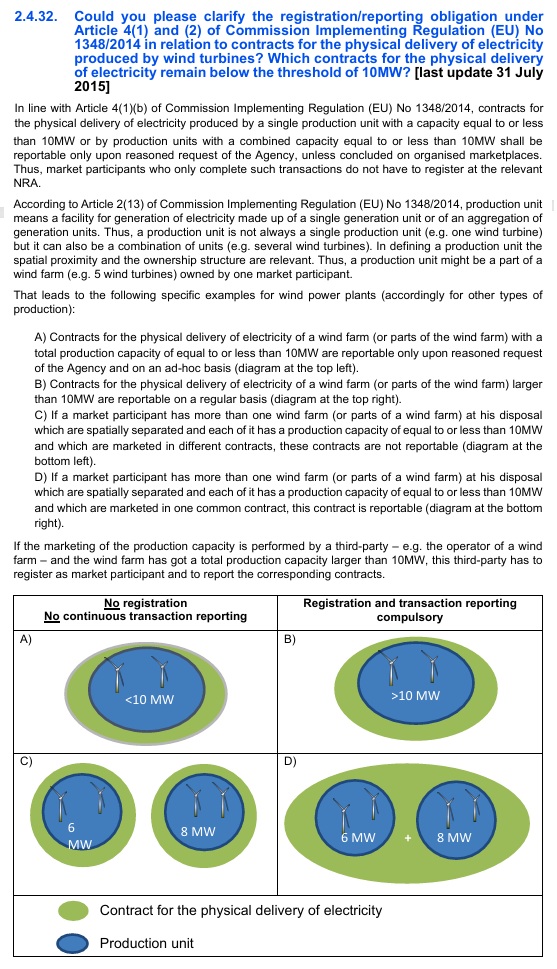
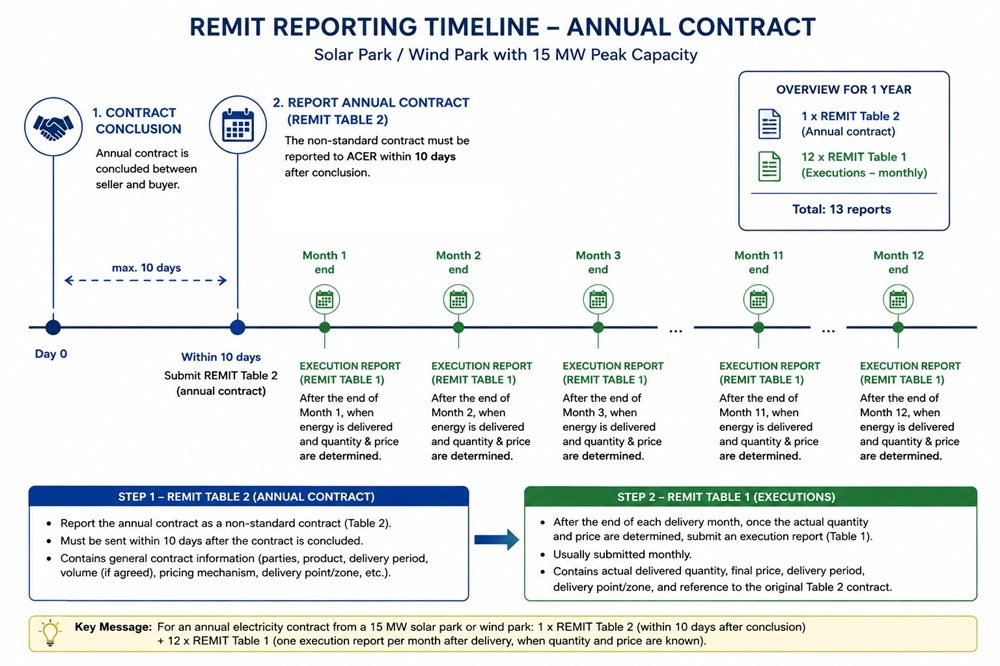
If electricity from a solar park or wind park with a peak capacity of 15 MW is sold under an annual contract, the reporting is usually done in two steps.
First, the annual contract is reported as a non-standard contract using REMIT Table 2. This report must be submitted within 10 days after the contract has been concluded.
This applies especially where the contract sets the framework for the delivery or marketing of electricity, but the final delivered quantity and/or the final price are only determined later.
After the end of each delivery month, once the electricity has been delivered and the actual quantity and price have been determined, execution reports must be submitted. These execution reports are reported using REMIT Table 1 and refer back to the original annual contract reported under Table 2.
For a one-year contract, this normally means:
Market participants engaging only in transactions for contracts in points (ii) and (iii) (≤ 10 MW for electricity, ≤ 20 MW for gas) are not required to register with the NRA under Article 9(1) of REMIT. more information …
According to Article 3(1) of Commission Implementing Regulation (EU) No 1348/2014, the Agency may request market participants to report certain contracts and transaction details, unless concluded on organized marketplaces:
Note: This FAQ collection has been compiled from various sources and reflects our understanding. It is provided for informational purposes only and is not legally binding. We do not take any legal responsibility for the accuracy or completeness of the information. For legal or regulatory matters, please consult a professional.