FAQ: ENTSO-E vs. REMIT – Outage Reporting and the 100 MW Threshold
Common questions on identifying and publishing inside information under REMIT.
Common questions on identifying and publishing inside information under REMIT.
Commission Regulation (EU) No 543/2013, commonly known as the Electricity Transparency Regulation, gives market participants access to standardised electricity market data, including power generation, transmission capacity and power plant outages.
Regulation (EU) No 1227/2011, known as REMIT, aims to prevent insider trading and market manipulation in wholesale energy markets. It requires market participants to publicly disclose inside information in an effective and timely manner. The same power plant outage can fall under both regulations.
ENTSO-E operates the European Transparency Platform for electricity market data. For outages covered by the Electricity Transparency Regulation, the plant operator generally supplies the required data to the relevant transmission system operator (TSO). ENTSO-E publishes the data and makes it available to ACER under Article 11 of Commission Implementing Regulation (EU) 2026/256.
ACER monitors wholesale energy markets in cooperation with national regulatory authorities. The market participant is responsible for ensuring that its inside information is disclosed in an effective and timely manner through an Inside Information Platform (IIP).
The ACER REMIT Manual of Procedures (MoP) covers the reporting of data to ACER. Section 6.2.1 (p. 19) describes ENTSO-E fundamental data and refers to the Electricity Transparency Regulation to define its scope. Chapter 7 (from p. 26) covers inside information reporting, and Annex VII (from p. 73) sets out the data fields for an Urgent Market Message (UMM).
Article 15(1)(a) and (b) covers planned unavailability of at least 100 MW, changes of at least 100 MW in planned unavailability, and changes of at least 100 MW in actual availability of an individual generation unit, where the event is expected to last for at least one market time unit. The threshold applies to the capacity affected by the event.
If a gas turbine’s available capacity drops from 120 MW to 60 MW, the change is 60 MW. The threshold for that individual generation unit is therefore not met. Separate criteria apply to the production unit as a whole under Article 15(1)(c) and (d)
Yes, if the information qualifies as inside information. REMIT has no general 100 MW minimum threshold for disclosure. The market participant assesses whether the information is precise, has not been made public, relates directly or indirectly to one or more wholesale energy products, and would be likely to significantly affect their prices if made public. The 60 MW reduction in the example may therefore require disclosure under REMIT.
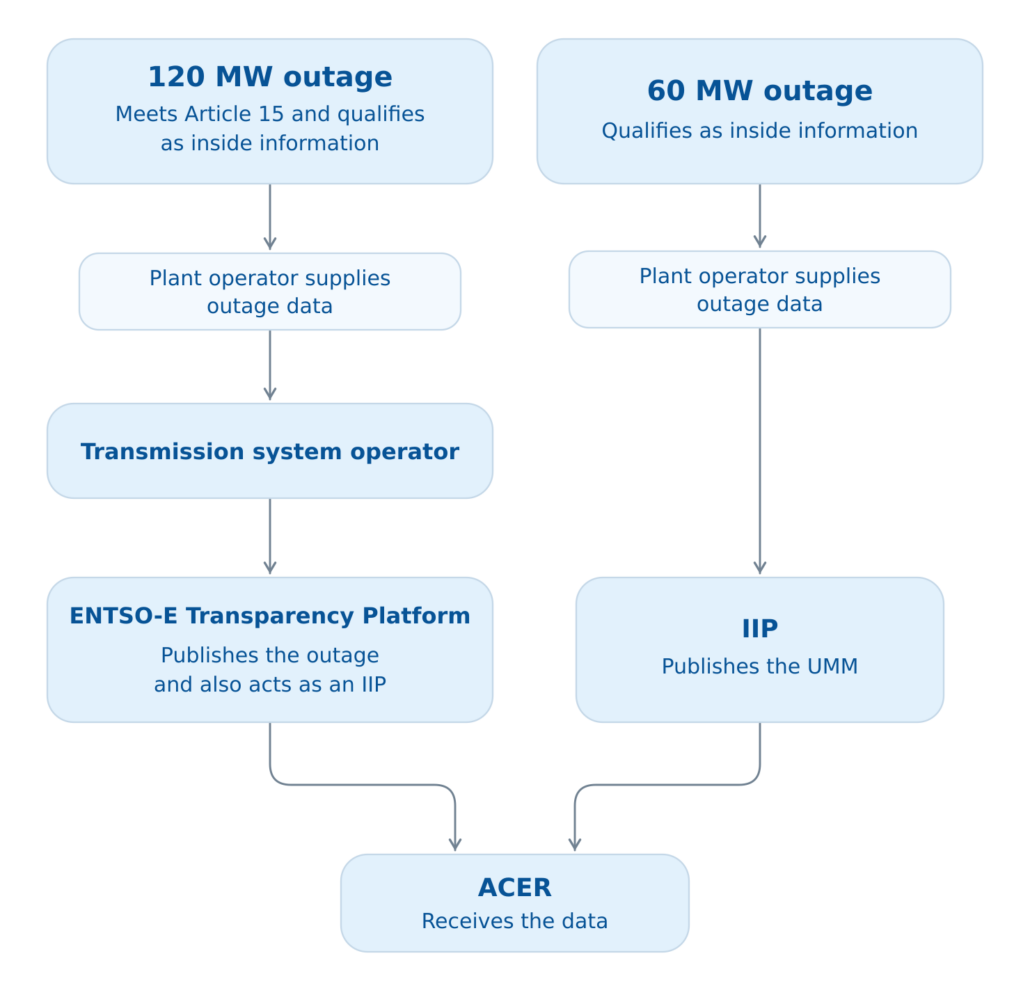
The diagram shows two reporting routes for power plant outages that qualify as inside information under REMIT.
A single publication can satisfy both obligations. The ENTSO-E Transparency Platform is itself listed as an IIP.
If it makes all relevant inside information about the same event publicly available in full, on time and in the required format, one publication is sufficient.
If the ENTSO-E process would omit the information, publish it only in part or publish it too late, you can use the IIP to disclose the full information promptly as a UMM. Any separate obligation to supply transparency data still applies through the agreed reporting channel.
Note: This FAQ collection has been compiled from various sources and reflects our understanding. It is provided for informational purposes only and is not legally binding. We do not take any legal responsibility for the accuracy or completeness of the information. For legal or regulatory matters, please consult a professional.