ACER REMIT Reporting for LNG Market
Practical guidance on REMIT reporting for LNG market participants — covering data collection via the TERMINAL platform, fundamental & transaction data rules, EU delivery scope, and ship unavailability disclosure.
Practical guidance on REMIT reporting for LNG market participants — covering data collection via the TERMINAL platform, fundamental & transaction data rules, EU delivery scope, and ship unavailability disclosure.
For LNG, there are generally four relevant reporting areas:
Market participants or LSOs on their behalf shall report to the Agency for each LNG facility the following information:
a) In relation to unloading and reloading of cargoes:
The market participant should provide to ACER the LNG Participant Activity Report (lngParticipantActivityReport). The LNG Participant Activity report contains details of all of the movement of LNG into and out of the facility by a market participant within a gas day.
LNG fundamental data relating to dates of unloading and reloading and volumes unloaded and reloaded per ship must be reported to the Agency by market participants no later than the working day following unloading or reloading.
b) The planned unloading or reloading at the LNG facilities in a daily resolution for the next month.
The report must specify the market participant and name of the terminal customer (if different from the market participant).
The market participant should provide to ACER the LNG Planned Usage Report (lngPlannedUsageReport). To be provided in advance of the month to which it relates.
The planned usage report provides a monthly forecast of expected usage of the facility for the month ahead.
Links:
Manual of Procedures on transaction data, fundamental data and inside information reporting
FAQs REMIT fundamental data and inside information (See questions 3.2.5, 3.2.7, 3.2.8)
The reporting of contracts for the supply of liquefied natural gas (LNG) should not be different than any other contract for the supply of natural gas. Most of the contracts for the delivery of liquefied natural gas at EU LNG terminals are non-standard contracts.
We have two cases for reporting on LNG contracts:
A) If the contract does not have a defined quantity or price you need send two messages:
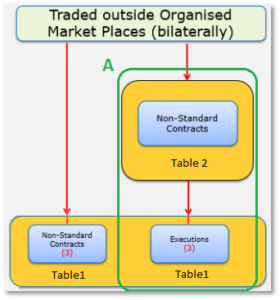
(Please see FAQ, Question 3.1.2, 3.1.21, 3.1.22, 3.1.24, 3.1.49)
B) If the non-standard contact has a defined (fixed) price and quantity.
This should be reported with: Table 1 for Non-Standard BILCONTRACT contracts with outright price and volume for the contract (as per normal pipeline gas supply contracts with outright price and volume).
Deadline: the contract should be reported within T+10 business days (new REMIT2 reuirement)
(Please see -> FAQ, Question 3.1.22 -> Scenario 6)
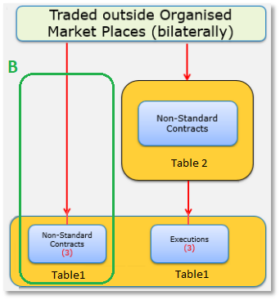
Any changes between the contractual volume and the final delivery volume should be reported as a lifecycle event with Action type “M” for Modify.
Deadline: within 1 month from the when price and volume are changed.
Contracts for the supply of LNG before the entry flange of an EU LNG regasification terminal are not subject to transaction reporting. (For example an exchange of title on the high seas outside the EU.)
Cargos traded under such contracts are subject to the reporting of fundamental data provided once the cargo is unloaded at an EU LNG regasification terminal.
If the cargo – once bought on the high seas outside the EU under this type of contract is re–traded by the buyer at or after the entry flange of an EU LNG regasification terminal, then the transaction related to the new contract will be subject to reporting.
(FAQ, Question 3.1.21)
The transportation contract from the regasification terminal to the gas terminal does not need to be reported. There are currently no requirements for the reporting of transportation contracts involving locations that are not balancing zones.
(FAQ, Question 4.2.20, 3.1.22 – 3.1.26, 3.1.49)
Are Virtual Gas Storage contracts reportable under REMIT?
Insofar as virtual gas storage contracts are not contracts for the supply (or transportation) of natural gas, they are not reportable under REMIT.
However, contracts for the supply of natural gas within storage and LNG facilities are reportable contracts. For instance, when market participant A sells gas to market participant B within a storage or LNG facility, transferring the ownership of the gas, this is a reportable contract.
(Questions and Answers on REMIT, Question 1.1.8)
Are contracts for the supply of liquefied natural gas (LNG) with delivery in the Union covered by the scope of REMIT?
Contracts for the supply of LNG, where delivery is in the Union, are wholesale energy contracts pursuant to Article 2(4)(a) of REMIT.
(Questions and Answers on REMIT, III.3.34)
What constitutes delivery of LNG into the European Union?
As far as liquefied natural gas (LNG) contracts are concerned, the Agency considers any importation or offloading of liquefied natural gas in any LNG facility (including flanges that connect the LNG vessel to the LNG terminal) as ‘delivery in the Union’ as far as the delivery of the product takes place in the European Union.
In the situation described above, assuming the delivery of the liquefied natural gas is in the European Union, both parties to the contract will need to register with the relevant National Regulatory Authority/ies as the contract is reportable to the Agency.
Reload-contracts at a regasification terminal or at a vessel where the delivery of the product is not the European Union are not reportable.
(Questions and Answers on REMIT, III.3.36)
Note:
The EIC W code of LNG terminal or a gas storage facility is the reporting of the delivery point.
Agency has indicated that where the gas is delivered at an LNG or a gas storage facility, then the EIC W code for that facility should be reported.
(FAQ on transaction reporting, Question 2.1.42 )
The reporting of contracts for the supply of liquefied natural gas (LNG) should not be different than any other contract for the supply of natural gas. The only difference between a contract for the supply of natural gas at a balancing area and the contract for the supply of liquefied natural gas at the LNG terminal is the reporting of the delivery point.
While market participants have to use EIC Y code for reporting the delivery of natural gas at balancing areas,
EIC W code should be used when the delivery is in the LNG terminals.
(FAQ, Question 3.1.2)
Are RRMs allowed to report fundamental data directly to ACER on behalf of market participants for “Unloading and Reloading of LNG” and for “Amount of gas stored”?
The market participants can delegate the reporting obligation to LSO/SSOs respectively or to any other registered RRM.
(Questions and Answers on REMIT, III.4.2)
The key element of the geographical scope is that a delivery point of such electricity or natural gas must be in the EU.
On the contrary, contracts for the supply of electricity or natural gas produced/generated outside the EU but delivered within the EU borders will be under the scope of REMIT.
Example: Situation: Bilateral over-the-counter contract for the delivery of LNG at the OLT offshore LNG terminal of Toscana (Italy).
The product is delivered in the EU – the LNG is delivered in EU territorial waters (Italian territorial waters – EU member state). It is not relevant for the qualification of the delivery as being in the EU if it is on an offshore or on onshore facility. As far as the contracts for the LNG supply are concerned, the Agency considers any delivery or offloading of LNG in any LNG facility (including flanges that connect the LNG vessel to the LNG terminal) as ‘delivery in the EU’ as long as the delivery of the product takes place in the EU.
ACER_Guidance_on_REMIT_application_6th_Edition_Final.pdf (europa.eu), Page 20
The concept of ‘transportation of electricity or natural gas’ in the EU shall be interpreted by NRAs as including at least one bidding zone/delivery point located inside the EU:
Example: Gas transportation contract for delivery of natural gas at the EU border
Situation: A market participant bought yearly firm transportation capacity of natural gas so that it can import natural gas from Russia into the EU (the contract stipulates that the entry point is in a Russian location and the delivery point is at the border between Ukraine and Slovakia).
Assessment: This contract is a wholesale energy product pursuant to Article 2(4)(c) of REMIT, as it fulfils all relevant criteria:
ACER_Guidance_on_REMIT_application_6th_Edition_Final.pdf (europa.eu), Page 21
In accordance with Article 8 of REMIT, market participants, or a person or authority on their behalf, shall provide the Agency with a record of wholesale energy market transactions, including orders to trade.
Reporting obligations cover:
a) market participants, which means any person, including transmission system operators, who enters into transactions, including orders to trade, in one or more energy markets. Entities entering into transactions via third parties (e.g. via a Direct Market Access service) are also considered market participants;
b) third parties acting on behalf of market participants (e.g. OMP members offering a Direct Market Access service);
c) trade reporting systems;
d) organised market places, trade matching systems or other persons professionally arranging transactions;
e) trade repositories registered or recognised under Regulation (EU) No 648/2012 (EMIR);
f) competent authorities which have received the information in accordance with Article 25(3) of Directive 2004/39/EC (MiFID) or ESMA when received in accordance with Regulation (EU) No 648/2012 (EMIR).
The Agency expects that market participants under REMIT may enter into transactions:
a. acting on their own account and on their own behalf (pure principal transaction – i.e. on the decision of the firm);
b. acting on their own account and on behalf of a client – i.e. on the order of other market participant; and/or
c. acting on the account and on behalf of a market participant (pure agency transaction)
d. acting on a third entity’s account and on their own behalf
The information about the unavailability or restrictions of the LNG vessel should be reported on the Inside Information platform.
This information is crucial to ensure transparency and provide market participants with the necessary data to make informed decisions.
Failure to report such unavailabilities or constraints could lead to market disruption, lack of transparency and potentially non-compliance with regulatory requirements.
Please use the ‘Other market information’ UMM data type to disclose such messages related to LNG ships.
MoP, TRUM, schemas, and FAQs
26 Mar 2026 — Data reporting procedures
17 Dec 2024 — Transaction Reporting User Manual
Implementing Regulation (EU) 2026/256
Note: This FAQ collection has been compiled from various sources and reflects our understanding. It is provided for informational purposes only and is not legally binding. We do not take any legal responsibility for the accuracy or completeness of the information. For legal or regulatory matters, please consult a professional.