ACER REMIT FAQ for Standard & Non-Standard Contracts
Key terms and practical questions about reporting of standard and non-standard contracts under ACER REMIT.
Standard & Non-Standard Contract
Regulatory update (29 April 2026)
How do you decide whether to use REMITTable1 or REMITTable2?
Executions & deadlines
Lifecycle events
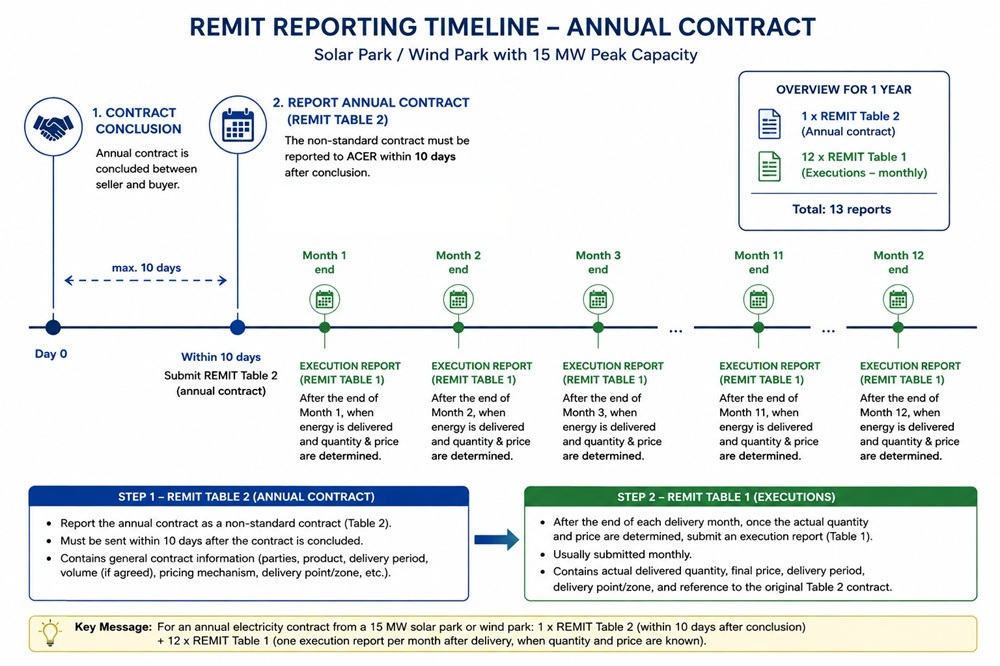
How should an annual contract for a solar park or wind park with 15 MW peak capacity be reported under REMIT?
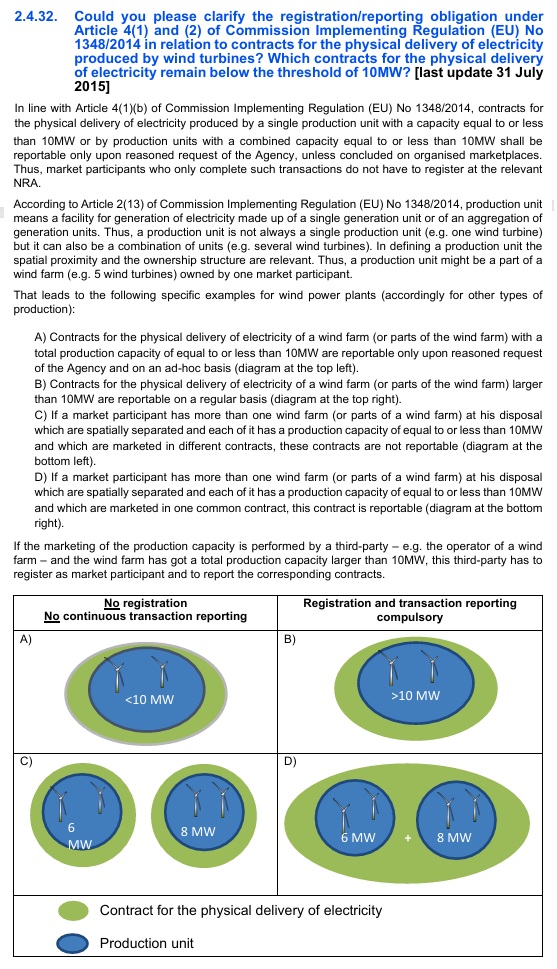
What is the Minimum Facility Capacity for ACER REMIT Reporting?
What is the scope of contracts reportable at request of the Agency?
Please note: The definition was amended with effect from 29 April 2026.
Under the recast REMIT Implementing Regulation:
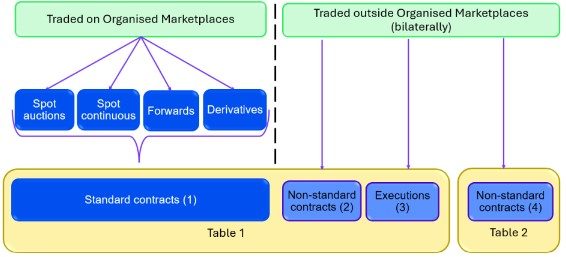
The EU has adopted a recast REMIT data reporting framework (Commission Implementing Regulation (EU) 2026/256). From 29 April 2026, ACER clarified updated definitions and reporting timelines for standard vs non-standard contracts.
Transition example: If a non-standard contract is concluded on 28 April 2026 (one day before entry into force of the recast REMIT IR), the one-month reporting timeframe still applies, and the transaction needs to be reported at the latest on 28 May 2026. Whilst if the transaction occurs on 29 April 2026, it will have to be reported at the latest by 13 May 2026 (T+10 business days under the new framework).
Most provisions apply with a transition period, but reporting parties should already align their processes with the new timelines.
→ Report using Table 1 (REMITTable1) within T+10 business days
→ Report the framework contract using Table 2 (REMITTable2) within T+10 business days
→ When price and quantity become known, report the related EXECUTION using Table 1, linked to the Table 2 Contract ID
Executions under non-standard/framework contracts are reported once the delivered quantity and final price are known and confirmed by the parties. This may occur only after delivery of the commodity and subsequent commercial reconciliation. (TRUM v7.0, sections 3.1.5, 3.1.6 and 3.3.2)
Once both market participants know the final volume and price, the transaction is considered complete. According to ACER, the details of such executions — including at least the outright volume and price — must be available to both parties by the invoicing date at the latest.
Therefore, executions under a non-standard/framework contract must be reported using Table 1 no later than 30 days after the invoicing date.
For these execution reports, Transaction timestamp (Field 30) should reflect the date on which the respective market participant confirms the price and quantity of the execution. As the exact confirmation time may differ between the two counterparties and an identical execution timestamp may therefore not be available, ACER allows the field to be reported with the date only.
Since the reporting schema requires a date-time value, the default time 00:01:00 UTC may be used.
In practice:
Lifecycle events are changes after initial reporting and must also be reported within the applicable deadlines:
If electricity from a solar park or wind park with a peak capacity of 15 MW is sold under an annual contract, the reporting is usually done in two steps.
First, the annual contract is reported as a non-standard contract using REMIT Table 2. This report must be submitted within 10 days after the contract has been concluded.
This applies especially where the contract sets the framework for the delivery or marketing of electricity, but the final delivered quantity and/or the final price are only determined later.
After the end of each delivery month, once the electricity has been delivered and the actual quantity and price have been determined, execution reports must be submitted. These execution reports are reported using REMIT Table 1 and refer back to the original annual contract reported under Table 2.
For a one-year contract, this normally means:
Market participants engaging only in transactions for contracts in points (ii) and (iii) (≤ 10 MW for electricity, ≤ 20 MW for gas) are not required to register with the NRA under Article 9(1) of REMIT. more information …
According to Article 3(1) of Commission Implementing Regulation (EU) No 1348/2014, the Agency may request market participants to report certain contracts and transaction details, unless concluded on organized marketplaces:
Note: This FAQ collection has been compiled from various sources and reflects our understanding. It is provided for informational purposes only and is not legally binding. We do not take any legal responsibility for the accuracy or completeness of the information. For legal or regulatory matters, please consult a professional.